Mediterranean oceans hit record highs, scientists warn of dire future impacts

Intense Marine Heat and Its Harmful Impact on Ecosystems
When ocean temperatures surge rapidly, the resulting heat stress can wreak havoc across marine habitats, with implications that ripple far onto terrestrial ecosystems.
Immediate Biological Consequences
- Coral Bleaching: Rising sea temperatures cause coral polyps to expel symbiotic algae, diminishing nutrient acquisition and increasing mortality rates.
- Fish Migration: Many species shift their habitats in search of cooler waters, disrupting local food webs and fishing economies.
- Algal Blooms: Warmer conditions can favor the proliferation of harmful algae, leading to oxygen depletion and toxic effects on marine life.
Secondary Effects on Land
- Coastal Flooding: Heat-induced sea‑level rise increases the frequency and severity of coastal inundations.
- Altered Weather Patterns: Warm ocean currents can influence atmospheric circulations, affecting rainfall and temperature over adjacent land areas.
- Economic Impact: Diminished fish stocks and damaged coastal infrastructure threaten local livelihoods and trade.
Mitigation Strategies
- Monitoring Programs: Investing in real‑time temperature tracking helps predict and manage heat events.
- Habitat Restoration: Protecting and rehabilitating mangroves and wetlands can buffer against temperature spikes and storm surges.
- Policy Action: Implementing stricter heat‑adaptation guidelines reduces the overall slow‑burn disaster risk to both marine and terrestrial environments.

Mediterranean Sea Breaks June Temperature Record
On 29 June, sea temperatures in the Mediterranean climbed to an unprecedented 26.01 °C, according to Copernicus data evaluated by Météo‑France. Current readings are roughly 3 °C above the long‑term average, with some French and Spanish coastal zones exceeding 4 °C rises.
Key Highlights
- All‑time high for June: 26.01 °C
- Western basin—the Balearic and Tyrrhenian seas—witnessed the most pronounced heating.
- Present weather conditions make an immediate temperature decline unlikely.
Broader Climate Context
The Mediterranean is identified as a highly vulnerable “climate‑change hotspot,” warming at a rate far above the global average. Scientists emphasize that if climate mitigation actions remain stagnant, persistent marine heatwaves could irreversibly transform the region’s ecological balance.
Marine heatwaves could devastate life in the Mediterranean Sea
Mega Marine Heatwave Ravages Mediterranean
Current Conditions and Expanding Threats
Across the southeastern coast of Spain and northern Morocco, a relentless marine heatwave is intensifying. The region now experiences “severe” and even “extreme” thermal events, as temperature levels rise steadily over weeks.
Potential Impacts on Marine Life and Human Industries
- Biodiversity – Coral reefs, fish communities, and marine invertebrates face mass mortality.
- Fisheries – Catch volumes could shrink and fish stocks may shift, putting pressure on local economies.
- Aquaculture – Farms of mussels and other shellfish risk disease outbreaks and decreased yields.
- Coastal Weather – Altered sea temperatures may affect regional climate patterns across southern Europe and North Africa.
Expert Insight
Dr. Kathryn Smith, a marine biologist from the UK’s Marine Biological Association, notes:
- Historical Mediterranean heatwaves produced significant biological damage.
- Past incidents included massive invertebrate die-offs, large beach‑wide seagrass losses, and disease occurrences in mussel farms.
- She predicts that this current event will likely mirror those prior catastrophes.
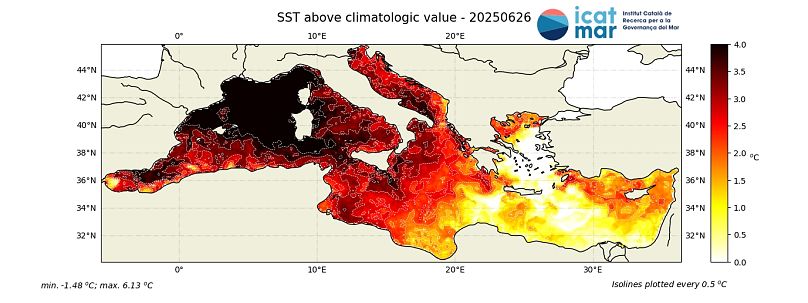
Sea‑Surface Temperature Anomaly Map – 26 June 2025 (ICATMAR)
Impact on Marine Ecosystems
- Coral bleaching: The heat wave has wiped out around 90 % of coral colonies in affected regions.
- Fan mussels on the brink: The noble fan mussel remains near critical levels of survival.
- Oxygen deficit: Warmer waters bind less dissolved oxygen, sparking mass fish die‑offs – a trend mirrored in Tuscany’s 2024 disaster.
- Bird mortality: As fish drift to cooler depths, seabirds miss their prey, leading to widespread avian die‑offs.
Downstream Effects on Coastal and Inshore Life
- Extreme weather amplification: Elevated sea temperatures intensify storm systems.
- Storm Daniel (2023):
- Increased probability by a factor of 50.
- Intensified intensity by 50 %.
- Resulted in nearly 6,000 fatalities across the Mediterranean.
- Valencia flooding (2024):
- High sea surface temperatures contributed to the severity of the event.
- Over 200 lives were lost.
Marine heatwaves thus ripple beyond the ocean, affecting birds, fisheries, and even land‑based climate phenomena, underscoring the urgent need for global temperature regulation.
Marine heatwaves are becoming more intense and lasting longer
Intensified Marine Heatwaves: A Harrowing Trend
Current State of Marine Heatwaves
Marine heatwaves today are ten times more intense and three times longer than those observed before the industrial era.
Expert Insight
“Climate change is driving the global increase in the frequency, duration, and intensity of marine heatwaves,” stated Dr. Alistair Hobday, research director of CSIRO’s Sustainable Marine Futures Programme.
Western Mediterranean Warming Crisis
The Mediterranean Sea has steadily warmed since the 1980s, with a sharp acceleration during the past decade. Over the last four decades, the number of marine heatwaves rose from one per year to an average of four per year, now affecting almost the entire basin. For the past five years, temperatures have remained persistently above the long‑term average.
Scientific Warning
Dr. Karina von Schuckmann, senior advisor at Mercator Ocean International, warned, “The widespread heatwave across the western Mediterranean now demands focused attention.”
Urgent Call for Action
Scientists emphasize that only rapid global emission reductions can halt this trend. Without decisive action, this climate hotspot could become permanently altered.
- Historical baseline: 1 marine heatwave per year (1980s‑2000s).
- Current average: 4 marine heatwaves per year (2020s).
- Potential future trajectory: Continuous above‑average temperatures without mitigation.