
EU Funds Drones Used by Israel in Gaza—Monitors Sound Alarm

European Parliamentarians Criticize Investment in Israeli Military Companies
Context
European Union Member‑State banks and investment funds have historically provided financing to a range of Israeli defense contractors. This practice has come under scrutiny by Members of the European Parliament (MEPs), who argue it conflicts with EU values concerning transparency, accountability, and ethical military engagement.
Key Concerns Raised by MEPs
- Human rights implications – Many Israeli defense firms supply technology used in overseas conflicts, raising questions about potential indirect violation of international law.
- Lack of disclosure – EU institutions reportedly lack clear criteria for assessing whether Israeli military exports align with broader EU policy objectives.
- Financial oversight – Critics allege that the current oversight mechanisms for cross‑border military financing are insufficient, risking misuse of EU funds.
Potential Consequences
For EU policy, opposing this type of financing might lead to:
- Stricter financial rules governing defense-related investments.
- Increased collaboration with international human‑rights bodies.
- Enhanced transparency efforts, such as publicly available lists of EU‑funded defense projects.
Summary
European MEPs have questioned the propriety of EU financial support for Israeli defense companies, urging a review of investment protocols to better align with EU principles of human rights, accountability, and ethical responsibility.

EU Funds for Drone Technology Used by Israel in Gaza Conflict
Two independent monitors have uncovered evidence that the European Union’s research and innovation funding programme has financed drone technology employed by Israel during its offensive in Gaza.
Key Findings
-
Statewatch and the Information Office of Militaryization (IMI) revealed that Xtend, a company producing drones for the Israeli Defence Force, obtained a €50,000 research and development grant from the Horizon Europe programme.
-
Despite a stated EU policy that restricts defence‑related projects from receiving public funds, various Israeli military entities have reportedly secured millions of euros for drone development in recent years.
-
The funds were directed toward a study aimed at enhancing the Skylord Xtender drone system and identifying strategic partners for its manufacturing and commercialization.
-
According to the monitors, Xtend subsequently signed agreements with the U.S. Department of Defence in 2021, which included participation by Israeli forces.
The European Commission has been asked for a comment. Further details may be released as investigations continue.
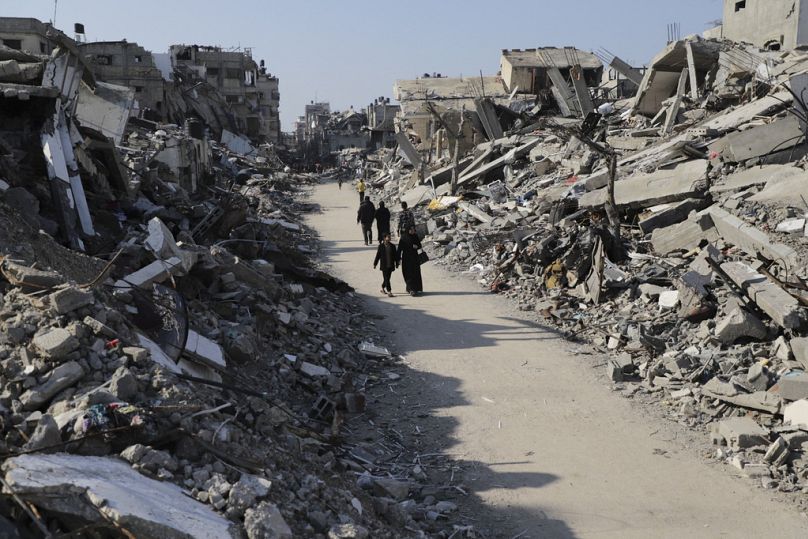
Palestinian Survivors Witness the Aftermath of Gaza Offensive in Jabaliya
On Thursday, February 29, 2024, individuals from the Jabaliya refugee camp walked through scenes of devastation wrought by the latest Israeli military campaign in the Gaza Strip. The images captured by Mahmoud Essa for the Associated Press reveal shattered homes, burning vehicles, and a landscape scarred by conflict.
EU‑Funded Science Hits Redundant Targeting Blame
Key Points:
- Human‑rights advocates urge the European Union to halt its association accord with Israel amid mounting civilian losses and infrastructure destruction.
- Statewatch director Chris Jones argues that publicly financed research should serve the common good, not corporate war profiteering.
- EU treaties explicitly prohibit funding for activities that have military or defence implications.
Military‑Centric Projects Receive EU Backing
Recent Statewatch‑IMI findings show numerous EU‑funded initiatives directed toward Israeli defence objectives. Notable programmes include:
- ResponDrone – Launched in May 2019, this project secured almost €8 million from EU funds to develop unmanned aerial systems for emergency and search‑and‑rescue missions. The same technology has surface potential for combat deployment.
- UnderSec – Awarded €6 million to augment drone systems with multi‑modal sensors and robotic elements, facilitating military applications.
Past Concerns Over EU Funding for Israeli Defence Innovations
In February, MEP Clare Daly highlighted that Horizon Europe money—taxpayer‑driven—was funneled into Israeli-made Pegasus spyware, a tool alleged to surveil journalists and politicians worldwide. She called for a review of Israel’s role in the programme.
“Early EU security research was rooted in dual‑use concepts, benefiting the European, Turkish, and Israeli arms industries,” stated Christoph Marischka of the IMI. “The research outcomes inevitably find use on various battlefields, such as Gaza.”
Calls for Suspension of Israel in Horizon Europe
In 2021, a coalition of 60 left‑wing and green MEPs urged the European Commission to bar Israel from Horizon Europe, arguing that the country’s actions could not be reconciled with the values underpinning the €95.5 billion programme. They insisted that research and innovation must not compromise human rights or international law.
Thus, as Gaza endures relentless offensives, stakeholders question whether EU funding – intended for public benefit – is inadvertently supporting militarisation and conflict.